Quick answer
On paper, a 72 km range sounds like enough for a full day without thinking about a charger. In Costa Rica, the calculation changes quickly. A long climb, several kilometers of gravel, tropical heat, sudden rain and a bike that weighs close to 38 kg can all reshape the ride. Motion has not yet completed an instrumented Costa Rica range test of this EB50. This analysis combines the official specifications with independent published tests, then applies those findings cautiously to local riding conditions.
Key takeaways
- Official power: 750 W nominal, 1,000 W peak and up to 85 Nm of torque.
- Official range: up to 48 km on throttle and up to 72 km with pedal assist.
- Cautious mixed-use planning estimate for Costa Rica: 40–55 km.
- Repeated hills, gravel, cargo and limited pedaling may reduce a practical plan to 30–45 km.
The 72 km claim meets Costa Rica reality
On paper, a 72 km range sounds like enough for a full day without thinking about a charger. In Costa Rica, the calculation changes quickly. A long climb, several kilometers of gravel, tropical heat, sudden rain and a bike that weighs close to 38 kg can all reshape the ride. Motion has not yet completed an instrumented Costa Rica range test of this EB50. This analysis combines the official specifications with independent published tests, then applies those findings cautiously to local riding conditions.
The 750 W motor is unlikely to be the first concern on a climb. The harder questions arrive later: how much battery remains for the return trip, how mechanical disc brakes feel on a long descent, and what happens if the rider must push or lift the bike. The EB50 has strong arguments in its favor, but planning around the full advertised 72 km would leave too little margin for a demanding Costa Rica route.
- Official power: 750 W nominal, 1,000 W peak and up to 85 Nm of torque.
- Official range: up to 48 km on throttle and up to 72 km with pedal assist.
- Cautious mixed-use planning estimate for Costa Rica: 40–55 km.
- Repeated hills, gravel, cargo and limited pedaling may reduce a practical plan to 30–45 km.
Quick answer: what should a Costa Rica rider expect?
The published tests show a consistent pattern. The EB50 accelerates confidently, tackles hills well for a fat-tire utility e-bike and feels planted on pavement and straightforward dirt roads. The same compromises also appear repeatedly: substantial weight, mechanical brakes and very little appeal if the bike must be carried up stairs.
For a first local route, we would plan around 40–55 km of mixed riding rather than the maximum claim. That is not a measured local result. It is a conservative operating window designed to preserve enough battery for unexpected elevation, a detour or a harder return leg.
Comparación
Comparison table
| Riding scenario | Planning range | Main variable |
|---|---|---|
| Pavement, steady pedaling and limited climbing | 55–70 km | Speed, wind and total weight |
| Mixed roads with moderate hills | 40–55 km | Elevation and high assist use |
| Gravel, frequent climbs or heavy cargo | 30–45 km | Rolling resistance, torque demand and load |
| Mostly throttle-powered riding | 35–48 km | Limited rider contribution |
Specifications we can confirm
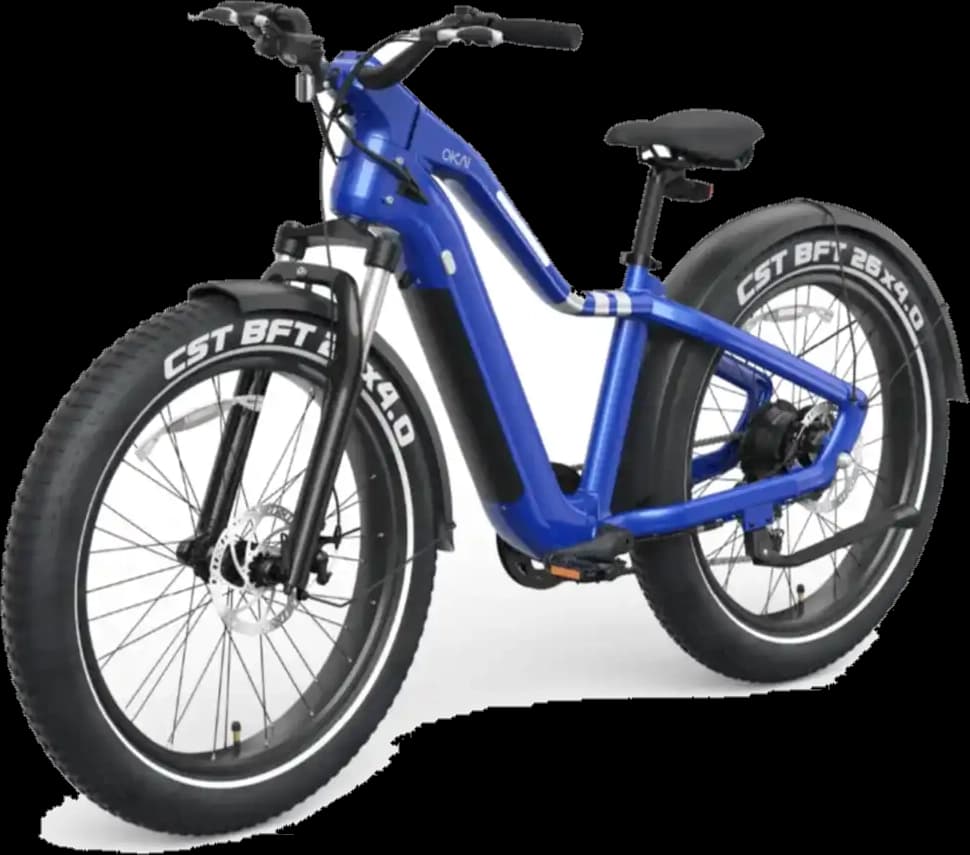
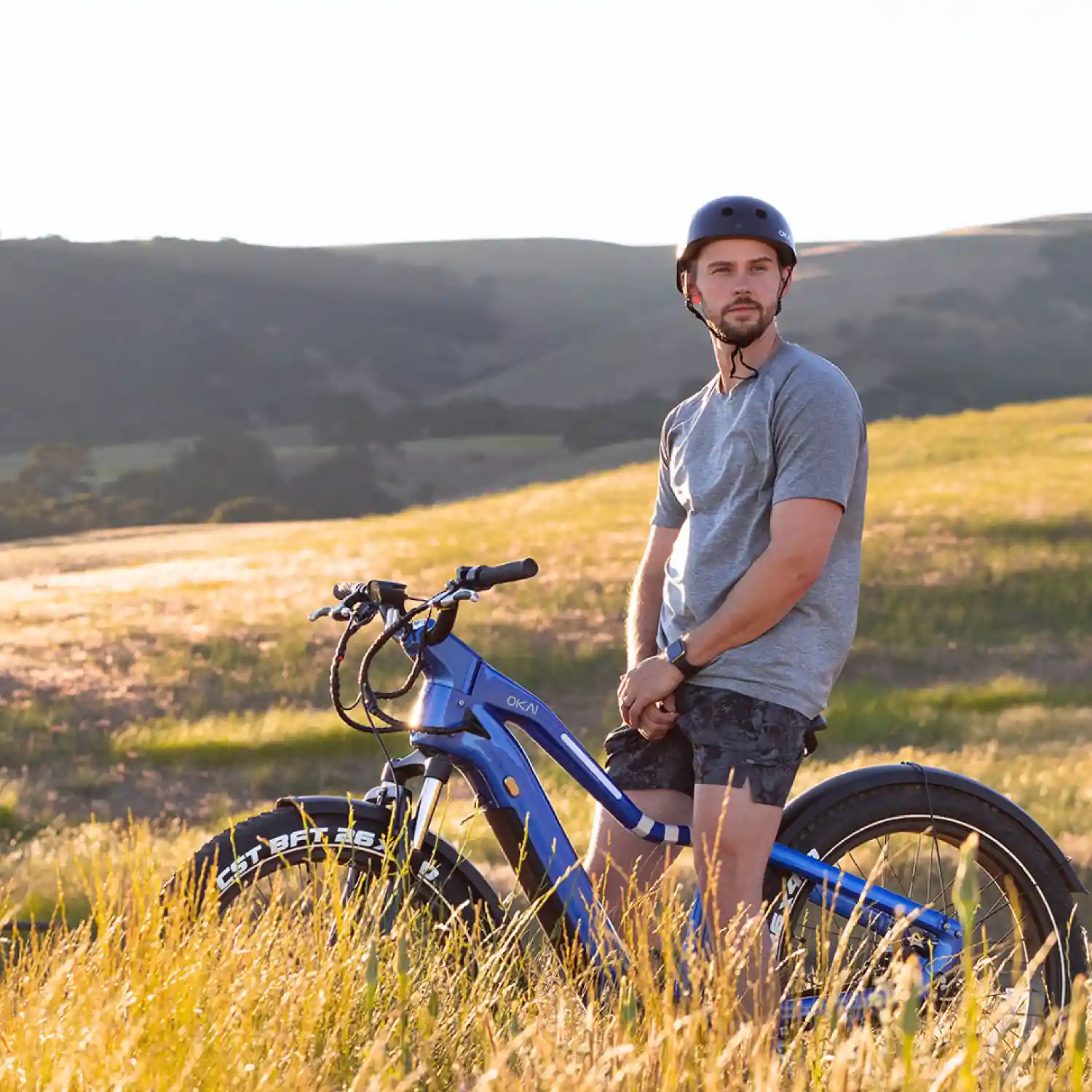
The confirmed hardware provides a useful starting point. The removable battery is rated at 48 V and 14.7 Ah, or approximately 705.6 Wh. The rear motor is rated at 750 W continuous output, reaches 1,000 W peak and is listed at up to 85 Nm. OKAI also specifies a charging time under six hours, a maximum payload of 150 kg and IPX5 water resistance.
OKAI publishes two range figures: up to 48 km using the throttle and up to 72 km with pedal assist. The words “up to” matter. A light rider pedaling on flat pavement does not use energy at the same rate as a rider carrying a bag up loose gravel with slightly low tire pressure.
Comparación
Comparison table
| Item | Official specification | Practical meaning |
|---|---|---|
| Motor | 750 W nominal / 1,000 W peak | Useful output for routes with elevation |
| Torque | Up to 85 Nm | Strong assistance when starting and climbing |
| Battery | 48 V · 14.7 Ah · about 705.6 Wh | The basis for realistic range estimates |
| Tires | 26 × 4 inches | Stability with additional rolling resistance |
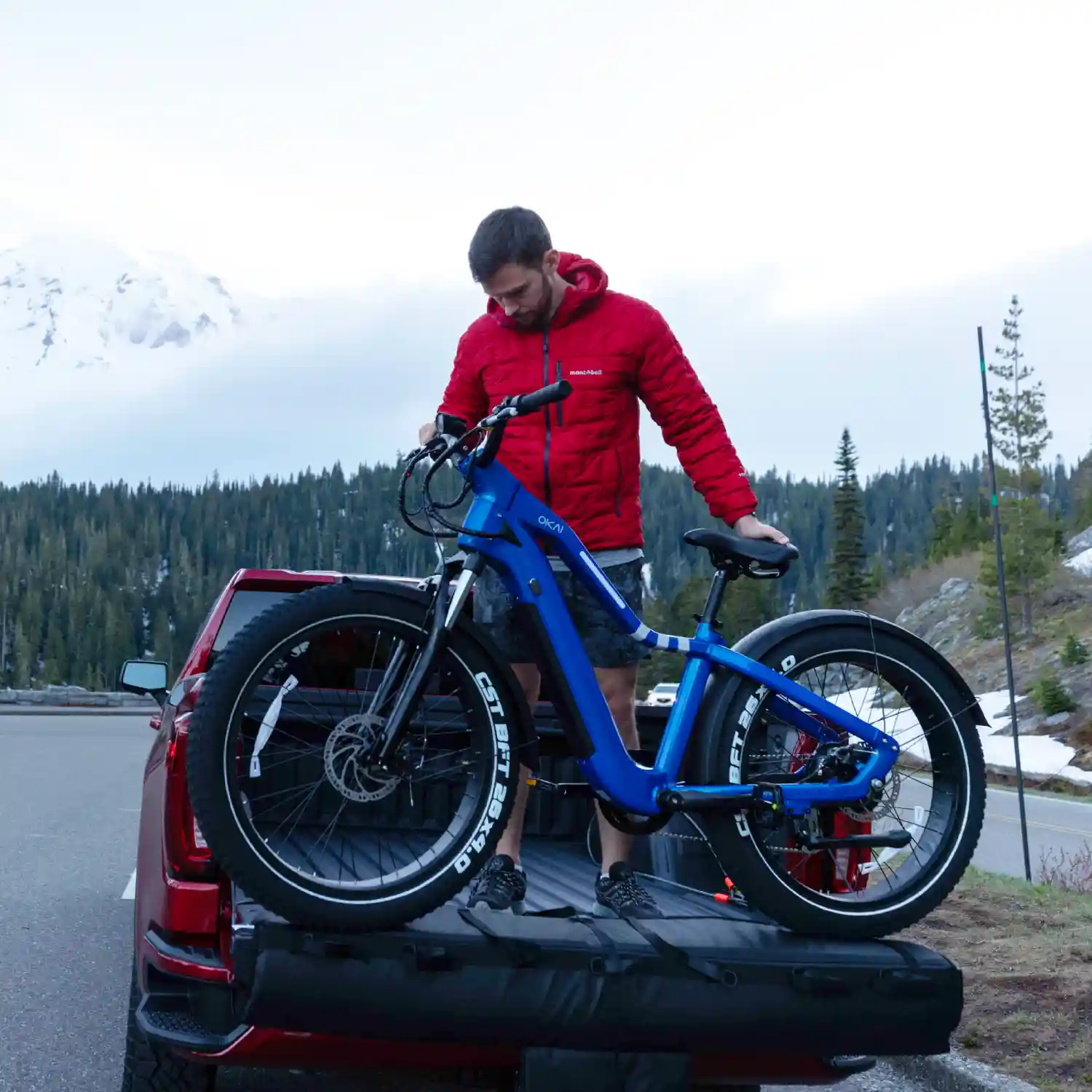
| Weight | About 38 kg | Difficult to lift, carry or load |
| Water resistance | IPX5 | Rain resistant, not submersible |
What independent reviewers actually found
Ebike Escape tested more than a short neighborhood loop. Its review separated throttle use, pedaling and assist levels, and included two hill climbs. The EB50 completed the climbs with both throttle and rider input. That does not reproduce a steep Escazú road, but it does show that the 750 W and 85 Nm figures translate into useful work.
Mountain Weekly News rode the EB50 on roads and light terrain near Grand Teton. The 26 × 4-inch tires provided a stable feel, while the motor performed through hills, mud and sand. The reviewer considered it comfortable for bike paths, roads and easier trails. BikeRide’s review summary reaches a similar conclusion: a comfortable upright position, quick acceleration and stability, balanced against considerable weight and modest component choices.
There is an important boundary. Being comfortable on dirt does not make this an enduro mountain bike. Large rocks, jumps and technical descents ask more from the suspension and place serious demands on mechanical brakes. The EB50 is better understood as a powerful all-road utility bike than a machine for aggressive trail riding.
How we estimated a realistic range
The basic math is transparent. If a 705.6 Wh battery delivered the full 72 km claim, consumption would average roughly 9.8 Wh per kilometer. Covering 48 km on throttle would imply about 14.7 Wh per kilometer. Those are useful reference points, not guarantees.
Real roads add resistance. Every climb keeps the motor under high load for longer. Wide tires and gravel increase rolling losses. Rider weight, cargo, headwinds, low pressure and repeated acceleration add to the energy bill. Instead of presenting one precise but misleading number, we use three consumption bands. The calculation also leaves a sensible reserve; reaching zero battery is especially unpleasant on a bike this heavy.
Comparación
Comparison table
| Demand level | Reference consumption | Calculated range |
|---|---|---|
| Efficient, strong rider contribution | 10–13 Wh/km | 54–70 km |
| Mixed, hills and frequent assistance | 13–18 Wh/km | 39–54 km |
| Demanding, gravel, cargo or repeated climbs | 18–23 Wh/km | 30–39 km |
Related reading
Three Costa Rica use cases without pretending we measured them
Energy figures become more useful when attached to familiar types of riding. These are route profiles, not recorded test loops. We are deliberately avoiding invented street names, elevation figures or weather measurements.
In the Central Valley, repeated starts, traffic and elevation dominate. Near the coast, compact gravel, heat and humidity enter the picture. On a farm or tourism property, speed may be lower, but cargo, uneven surfaces and many short accelerations can still consume meaningful energy. The bicycle is unchanged; the workload is not.
Comparación
Comparison table
| Local profile | Initial range budget | Decision before departure |
|---|---|---|
| Urban route with hills and stops | 40–55 km | Reserve energy for the return and repeated starts |
| Coastal roads, compact gravel and heat | 30–45 km | Check pressure, cargo and an alternate route |
| Farm or tourism property | 35–50 km | Measure total load and avoid depending on the last battery bar |
Climbing power is only half of the hill story
Up to 85 Nm and a 750 W nominal motor are encouraging when the road points upward. Good riding technique still matters. Shift into a lower gear before the steepest section, contribute through the pedals and preserve energy for the return. The throttle can start the bike under load, but repeated full-power launches consume battery quickly.
Descending deserves at least as much attention as climbing. Mountain Weekly identified the mechanical disc brakes as a weak point on a bicycle this powerful and heavy. Cable adjustment and pad condition matter more when nearly 38 kg of bike is pushing downhill. Riders with long daily descents should make brake inspection part of the route plan, not an occasional afterthought.
- Select a low gear before the hardest part of a climb.
- Avoid repeated maximum-power starts with a heavy load.
- Inspect brake pads and cable tension before long descents.
- Plan battery use around elevation, not distance alone.
Rain, humidity and wet roads
An IPX5 rating provides reassurance against rain and splashes, but it does not make the EB50 waterproof. Deep standing water, outdoor overnight storage in heavy rain and pressure washing remain poor ideas. A wet charging port should be allowed to dry completely before the charger is connected.
Water also changes traction and braking. Costa Rica’s MOPT warns that wet conditions lengthen stopping distance and make road paint and metal surfaces more hazardous. We found no credible test measuring this bicycle’s range loss in tropical rain. Assigning a neat percentage would sound authoritative without being supported, so we do not do it.
- Reduce speed before painted lines, metal covers and standing water.
- Dry the frame, display and charging area after a wet ride.
- Do not charge until the port is fully dry.
- Store under cover and remove mud without a pressure washer.
Weight, transport and storage
Thirty-eight kilograms feels manageable while the motor is helping. It feels entirely different in front of stairs, a high vehicle rack or a dead battery. A Costa Rica owner reported that the bike worked well between home, work and a farm; when asked about the disadvantage, the answer was its weight. One owner’s experience is not a controlled test, but it closely matches the international reviews.
A level garage can make the issue almost disappear. An upstairs apartment without an elevator, daily multimodal travel or frequent loading into a vehicle can turn the weight from a specification into the main reason to choose another bicycle. Buyers should physically rehearse where the bike will sleep and how it will be moved before deciding.
Fat tires and local replacement parts
The 26 × 4-inch tires are central to the EB50’s character. They smooth smaller irregularities, look substantial and help the bike feel settled on mixed surfaces. They are also less common than standard bicycle sizes. Costa Rica riders have noted that matching tubes and tires may not always be easy to find. That anecdote does not prove a nationwide shortage, but it is enough reason to confirm supply before purchase.
Ask about the inner tube, tire, charger and brake pads, including realistic replacement times. Motion lists EB50 parts, but a catalog page cannot repair a puncture by itself. What matters is whether the right part and service path exist when the bike is off the road.
The strongest reasons to buy—and to pause
The EB50 is not trying to be subtle or light. It is a large, upright and powerful e-bike for riders who value stability, comfort and meaningful motor assistance. It makes far less sense for someone who must carry it every day or whose regular route is a technical mountain-bike trail.
Its most convincing combination is the strong motor, removable battery, broad tires and practical riding position. The important cautions are the 38 kg weight, mechanical brakes, only three assistance levels and the need to verify local parts compatibility.
- Best fit: commuting, farms, tourism properties and non-technical mixed roads.
- Less suitable: daily stairs, public transport and aggressive trail riding.
- Primary reason to buy: strong assistance with a stable, comfortable platform.
- Primary reason to reconsider: difficult handling whenever motor assistance is unavailable.
Research-based verdict
After comparing the specifications, independent tests and energy calculations, the EB50 holds up well. It has useful power, feels stable and should handle many everyday Costa Rica climbs competently. The advertised 72 km is not impossible; it belongs to a favorable day with meaningful rider input, efficient terrain and disciplined speed. It is not the number we would promise for a typical mixed local route.
For an initial ride, 40–55 km is the planning window we would choose. With gravel, cargo, frequent climbing or limited pedaling, we would reduce that plan to 30–45 km. These are not local test results. They are cautious estimates intended to keep a rider from having to push a 38 kg bicycle home.
The test we still want to publish is straightforward: GPS running, elevation visible, tire pressure recorded, total rider-and-cargo weight documented, and battery percentage measured before and after. When Motion completes that test in Costa Rica, the results should be published even if they contradict this analysis. That is what separates a useful test from an advertisement.
- Our current mixed-use planning estimate: 40–55 km.
- The strongest feature: motor output and planted handling.
- The biggest compromise: 38 kg and difficult transport.
- The next evidence needed: a documented Costa Rica route with GPS and battery data.
Related reading